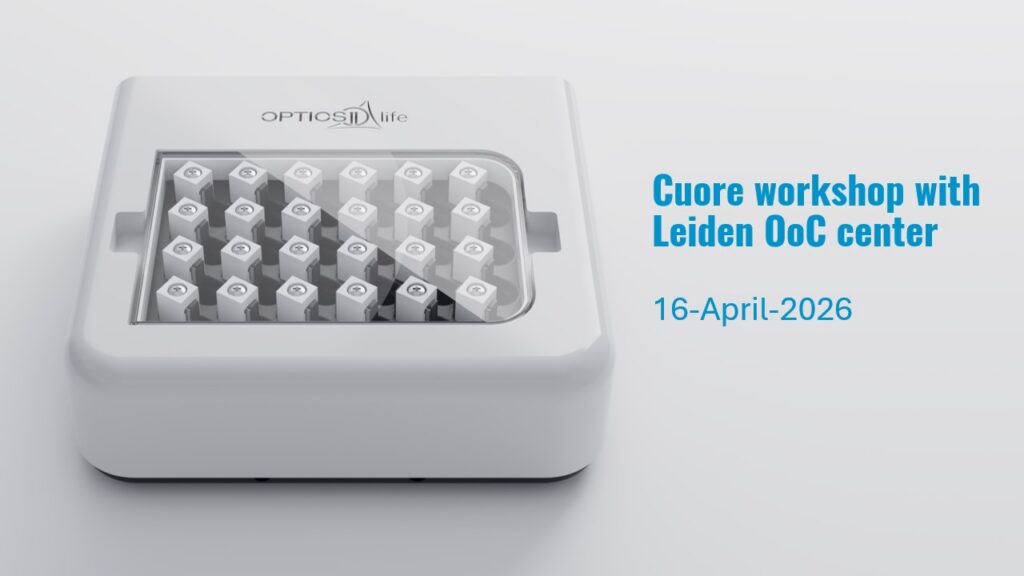
Cuore supports patient-derived 3D muscle research to assess the efficacy of Atrogi’s investigational oral drug ATR-258
- Directly measuring muscle function: Optics11 Life’s Cuore platform combines with LUMC’s expertise in FSHD and 3D tissue biology to model disease and assess drug response by directly measuring muscle contractility.
- Advancing human-relevant drug testing: The collaboration aims to advance New Approach Methodologies (NAMs) that capture functional drug effects early in preclinical development and complement molecular readouts.
- Investigating a potential therapy: ATR-258 reduced DUX4 and its target genes in FSHD patient-derived muscle cells. In a separate eight-week human study, it increased lean mass and lower-extremity muscle power.
- €3 million Eurostars program: STAMINA brings together Atrogi, Leiden University Medical Center, Karolinska Institutet, Stockholm University, Optics11 Life, and the National Research and Innovation Institute (NIRI).
AMSTERDAM, the Netherlands, 2 November 2026. STAMINA, a €3 million European program led by clinical-stage biotechnology company Atrogi, aims to advance its first-in-class investigational oral drug ATR-258 for facioscapulohumeral muscular dystrophy (FSHD). As a partner in the Eurostars co-funded consortium, Optics11 Life contributes its Cuore 3D muscle contractility platform and expertise to directly measure muscle function in patient-derived 3D muscle models and assess drug response.
Combining patient-derived FSHD models with muscle function measurements
FSHD is one of the most common muscular dystrophies, affecting roughly one in 8,500 people, and has no approved treatment. The collaboration combines Leiden University Medical Center’s (LUMC) expertise in FSHD and 3D tissue biology with Cuore to model the disease and evaluate drug efficacy in muscle tissues derived from patients.
The collaboration highlights the growing role of human-relevant New Approach Methodologies (NAMs) in translational drug development. By measuring the contractile force generated by engineered muscle tissues, Cuore enables researchers to assess functional responses to candidate treatments alongside molecular and cellular endpoints. This approach can help establish earlier whether a drug’s biological effects translate into measurable changes in muscle performance, informing preclinical development decisions.
“We are proud to be part of this consortium with Atrogi and contribute to the development of a potential therapy for FSHD,” said Svetlana Pasteuning-Vuhman, Scientific Business Development Lead at Optics11 Life. “By combining LUMC’s expertise in FSHD and 3D tissue biology with Cuore, we can directly measure how patient-derived muscle tissues contract and respond to treatment. These functional measurements help us address a central question in muscle disease research: does a potential treatment improve muscle function?”
She adds: “Having completed my PhD research in Duchenne muscular dystrophy (DMD), where much of my work focused on mouse models, I am personally motivated by the opportunity to contribute to more human-relevant models for developing better medicines. This is especially important for FSHD, a disease with complex biology and human-specific aspects that can be challenging to capture fully in conventional models.”
Investigating ATR-258 as a potential FSHD therapy
FSHD is driven by DUX4, a gene normally silent in adult muscle but that becomes active in people with the disease, progressively weakening the muscles of the face, shoulders, and limbs. ATR-258 is designed to address both the underlying disease biology and its consequences for muscle function. In preclinical studies using FSHD patient-derived muscle cells, ATR-258 reduced DUX4 and the genes it activates, pointing to potential disease-modifying activity.
In a separate eight-week human study involving 13 adults with overweight or obesity, ATR-258 increased lean mass by 0.8 kg and lower-extremity muscle power by approximately 13%. The treatment was well tolerated in this study. These findings support further investigation, although efficacy and safety in people with FSHD remain to be established.
“This Eurostars award is a strong endorsement of our platform,” said Dr. Paul Little, Chief Executive Officer of Atrogi. “With preclinical data pointing to disease modification and human data showing gains in muscle power, FSHD is a natural first rare disease for ATR-258.”
Using functional data to inform clinical development
Within STAMINA, ATR-258 will undergo further testing in 3D muscle models grown from FSHD patients’ own cells at LUMC. Cuore provides direct contractility measurements to help assess whether treatment-related molecular changes are accompanied by improvements in muscle function. Through this work, the consortium is further developing Cuore’s use in drug-testing workflows for muscular dystrophies and small-molecule therapies. The results will inform a first clinical trial of ATR-258 in people with FSHD, which Atrogi is preparing for 2027.
“This program represents an exciting opportunity for both the FSHD field and the patients who urgently need new treatment options,” said Professor Silvère van der Maarel, whose group at Leiden University Medical Center led the discovery of the genetic causes of FSHD. “The unmet medical need in FSHD remains substantial, and ATR-258 has the potential to offer a unique dual benefit by promoting muscle growth while simultaneously suppressing DUX4, the underlying driver of the disease. I am excited to work with Atrogi to advance this innovative approach.”
ATR-258 originates from Atrogi’s GRK2-biased β2-agonist platform, described in Cell in 2025 alongside findings from a 69-subject Phase 1 study. It is being developed as a once-daily oral capsule designed to avoid the receptor desensitization and cardiovascular side effects associated with conventional β2-agonists.
“What began as basic research in my lab at Stockholm University has now gone from bench to clinic,” said Professor Tore Bengtsson, founder and Chief Scientific Officer of Atrogi. “Our first-in-human trial and an investigator-initiated study have shown that ATR-258 is well tolerated and acts on human muscle, opening clear opportunities in muscle-sparing weight loss and sarcopenia. We now see great potential in rare muscle disease, and FSHD is where we start.”
About STAMINA
STAMINA (Stimulation of Adrenergic Receptors for the Inhibition of Muscular Atrophy) is a 36-month program co-funded through Eurostars and Vinnova. Atrogi leads the consortium, which includes Karolinska Institutet, Stockholm University, Leiden University Medical Center, Optics11 Life, and the National Research and Innovation Institute (NIRI, Latvia). The program focuses on FSHD while also assessing the approach’s potential relevance to other muscle-wasting conditions.
[Project reference: Eurostars 11249.]
About Optics11 Life
Optics11 Life develops instruments that help researchers measure the mechanical properties of biological materials and the function of engineered muscle tissues. Its Cuore platform directly measures contractile force in 3D engineered muscle tissues, supporting research into muscle biology, disease modeling, and drug response. By measuring stiffness, viscoelasticity, and contractility, Optics11 Life helps researchers connect mechanical properties with biological function.
Learn more about mechanobiology
Curious how mechanics can transform your research? Explore our mechanobiology platforms Pavone, Cuore, Chiaro, and Piuma and see how quantitative mechanical insights can enhance your 3D models, disease studies, and drug screening. Click here to learn more about our products >>
Get in contact
Want to discuss your application? Contact our team to explore which platform fits your research and schedule a demo. Click here to get in contact with us >>