Advanced human cardiac models are playing an increasingly important role in disease modeling, drug discovery, safety pharmacology, and regenerative medicine. As their use expands, the ability to generate physiologically relevant, reproducible data across experiments, laboratories, and analytical platforms is becoming increasingly important for advancing research and translation.
Why standardization and reproducibility matter in cardiac research
Standardized protocols are especially important for developing and adopting New Approach Methodologies (NAMs). Advanced human cardiac models can provide more relevant insights into human biology than conventional two-dimensional cultures. However, differences in tissue generation methods, culture conditions, and functional assessment approaches can make it difficult to compare results across studies. Greater standardization is essential to improve reproducibility, build confidence in physiologically relevant cardiac models, and accelerate their adoption across academia, industry, and regulatory settings.
A partnership to support more consistent cardiac research
Optics11 Life has entered a strategic partnership with Axol Bioscience to support the development and broader adoption of physiologically relevant human cardiac models.
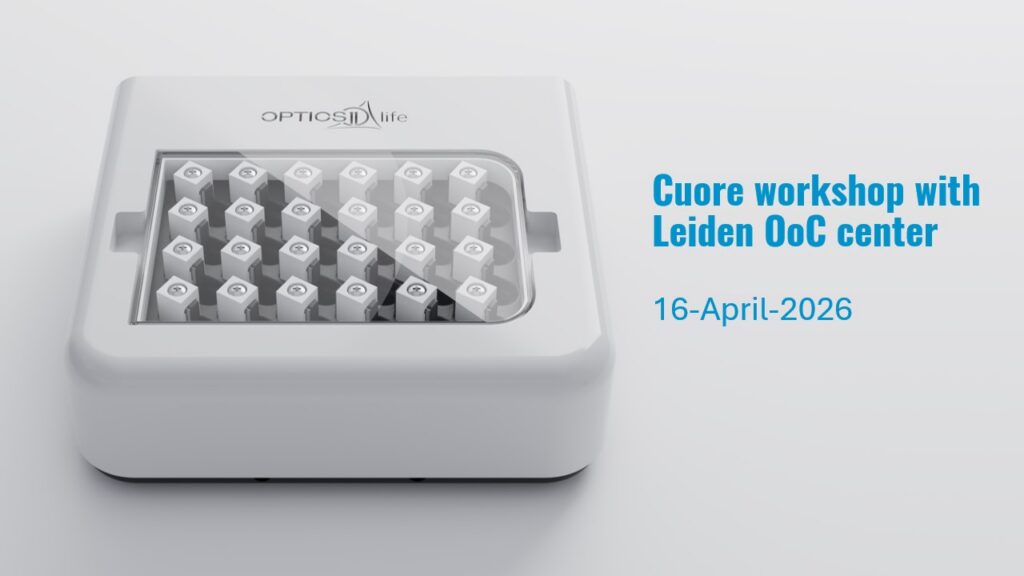
The collaboration brings together Axol Bioscience’s expertise in human induced pluripotent stem cell (iPSC)-derived cardiomyocytes with the Cuore platform from Optics11 Life. Cuore enables researchers to apply electrical stimulation and quantitatively measure the contractile function of three-dimensional engineered cardiac tissues.

A standardized workflow for engineered cardiac tissue generation and analysis
A central outcome of the partnership is the release of a standardized and validated protocol for generating and functionally assessing engineered cardiac tissues using axoCells™ human iPSC-derived cardiomyocytes and the Cuore platform.
The protocol provides researchers with a defined workflow for tissue preparation, culture, electrical stimulation, and contractility assessment. By reducing variation in how cardiac tissues are generated and analyzed, the workflow is designed to improve consistency between experiments and support more reliable comparison of results.
By combining well-characterized human cardiomyocytes with a validated workflow and quantitative functional measurements, Axol Bioscience and Optics11 Life aim to provide researchers with a more consistent approach to engineered cardiac tissue generation and analysis. Explore the complete Cuore cardiac solution, combining quality-controlled human iPSC-derived cardiomyocytes, a validated cardiac protocol, and direct contractility measurements with Cuore.
The approach lets researchers connect cellular and molecular observations with tissue-level functional outcomes, including contractile force, tissue maturation, electrical pacing response, and changes following treatment.
The collaboration will support applications in cardiovascular disease modeling, drug discovery, safety pharmacology, cardiotoxicity testing, and regenerative medicine. It can also help researchers generate the consistent evidence needed to build confidence in human-relevant cardiac models among academic, pharmaceutical, and regulatory communities.
“We’re excited about this partnership and the opportunity to apply our iPSC-derived cardiomyocytes in a 3D engineered heart tissue (EHT) model. This approach enables more mature functional responses, including the positive inotropic response to isoprenaline, an effect that is often difficult to reproduce in conventional 2D assays. We’re also enthusiastic about the Cuore system’s multi-well format, which combines the advantages of 3D tissue models with the throughput needed for scalable in vitro studies,” said Jamie Bhagwan, Scientific Group Leader, Axol Bioscience.
“We’re excited about our partnership with Axol Bioscience and the opportunity to combine their high-quality iPSC-derived cardiomyocytes with Optics11 Life’s Cuore platform. By bringing together Axol’s well-characterized cells, Cuore’s highly sensitive and high-resolution functional readouts, and a ready-to-use protocol, we can make the transition to 3D cardiac models faster and more accessible. Customers can generate reproducible, high-quality data and capture subtle functional responses in engineered heart tissue that conventional approaches may miss, without spending significant time and resources developing and optimizing their own 3D model. This ready-to-use workflow can accelerate onboarding, shorten the path from cells to meaningful drug data, and help researchers adopt advanced 3D cardiac models with greater confidence,” said Svetlana Pasteuning, Business Development Lead, Optics11 Life.
Driving the adoption of reproducible human cardiac models
Through this partnership, Axol Bioscience and Optics11 Life are helping make advanced cardiac tissue models more reproducible, accessible, and practical for wider use in preclinical research and drug development.
Learn more about mechanobiology
Curious how mechanics can transform your research? Explore our mechanobiology platforms Pavone, Cuore, Chiaro, and Piuma and see how quantitative mechanical insights can enhance your 3D models, disease studies, and drug screening. Click here to learn more about our products >>
Get in contact
Want to discuss your application? Get in touch with our team to explore which platform fits your research and to schedule a demo. Click here to get in contact with us >>