Stiffness is a core part of the cellular microenvironment, yet standard cell culture still relies heavily on rigid plastic that sits far outside physiological conditions. In this Faces of Mechanobiology entry, Justin Mih shares how observing cells across different physical contexts shaped his perspective, and why stiffness became central to mechanobiology and to building practical tools for everyday workflows. The article also highlights how mechanics can influence gene regulation and disease biology, and why precise mechanical measurement is scientifically critical for reproducibility in stiffness controlled culture.
Measuring What Cells Feel: How Stiffness Became a Mission
For decades, researchers have grown cells on rigid surfaces, an approach that helped transform modern biology by making cell culture scalable and reproducible. But with this convenience came a major limitation: these surfaces bear little resemblance to the soft mechanical environments cells encounter within the body. In doing so, they overlooked a fundamental reality: stiffness matters.
That realization became the foundation of Justin Mih’s journey into mechanobiology and the founding of his company, Matrigen. Early in his career, Mih had carried out experiments that would profoundly shape how he thought about cells. He had seen fibroblasts embedded in floating collagen gels become strikingly quiescent compared with cells grown on rigid dishes. He had cultured airway epithelial cells at an air-liquid interface and watched them develop cilia and produce mucus. He had exposed endothelial cells to simulated microgravity and observed extensive cytoskeletal reorganization. For Mih, the takeaway was clear: the physical context surrounding a cell was not just background. It was instructive.
At the time, cell biology was beginning to embrace the idea that dimensionality itself, particularly 3D culture, was a critical factor governing cell behavior [1]. Mih was certainly a proponent, but his perspective shifted when his PhD adviser handed him a paper that would become foundational to mechanobiology: “Tissue Cells Feel and Respond to the Stiffness of Their Substrate,” published in Science in 2005 by Dennis Discher, Paul Janmey, and Yu-Li Wang [2].
“It was one of those moments where everything suddenly clicked into place,” Mih recalls.
The paper presented a transformative idea: cells are not passive entities sitting on a surface, but active participants that probe, pull on, and respond to the mechanical properties of their surroundings. In soft tissues, cells deform the extracellular matrix and receive mechanical feedback. On tissue culture plastic, however, that feedback falls far outside the physiological context. For Mih, the first clue was visual: many cells exhibited striking changes in morphology across a physiologically relevant range of stiffness. But the more provocative question was what was happening beneath the surface.
It turns out, quite a lot. Cells grown outside their physiological stiffness range don’t just change shape, but can gradually lose defining characteristics at the level of gene regulation and phenotype. This was demonstrated in a recent study using Matrigen hydrogels, in which Cosgrove and colleagues identified a new class of genomic enhancers that respond to the mechanical microenvironment, directly linking substrate mechanics to transcriptional output [3]. The existence of these mechanoenhancers implies that stiffness doesn’t just influence how a cell behaves — it may epigenetically reprogram what that cell becomes. In other words, a fibroblast grown on plastic isn’t just sitting in the wrong environment. It may be quietly becoming a different cell.
That deeper understanding has reshaped how researchers think about disease. In fibrosis and cancer, tissue stiffening is increasingly recognized not just as a byproduct of pathology but as an active driver of it. One study using defined-stiffness substrates showed that ECM stiffening shifted cancer cells and carcinoma-associated fibroblasts toward metabolic cooperation, essentially rewiring nutrient exchange between cell types to fuel tumor growth [4]. Reinforcing this picture of mechanical crosstalk, another found that stiffness alone could induce stromal autophagy in fibroblasts, causing them to break down their own intracellular components into metabolites that neighboring tumor cells could consume. When autophagy was blocked, stiff-matrix fibroblasts lost much of their ability to promote tumor growth [5]. The stakes of getting the mechanics right extend even to how tumors respond to therapeutic targets. In glioblastoma, myosin IIA drives tumor invasion but also suppresses tumor growth — and which of these roles dominates depends on the stiffness of the surrounding brain tissue. Block it to stop invasion, and you may inadvertently accelerate proliferation [6]. The matrix, it seemed, wasn’t just a scaffold. It was giving instructions.
Those findings helped confirm what Mih had suspected from the beginning: stiffness was not a niche variable, but a core feature of the cellular environment. Yet the means to study it remained a barrier. Many hydrogel-based systems are difficult to fabricate and hard to integrate into standard laboratory protocols [7]. For Mih, that gap was impossible to ignore. If mechanobiology was going to make an impact on mainstream biology, the field needed tools that were accessible enough for everyday use. Matrigen grew out of that challenge: turning a core biological principle into a practical reality.
“We wanted researchers to think about stiffness as effortlessly as they think about media conditions and drug concentrations,” Mih explains.
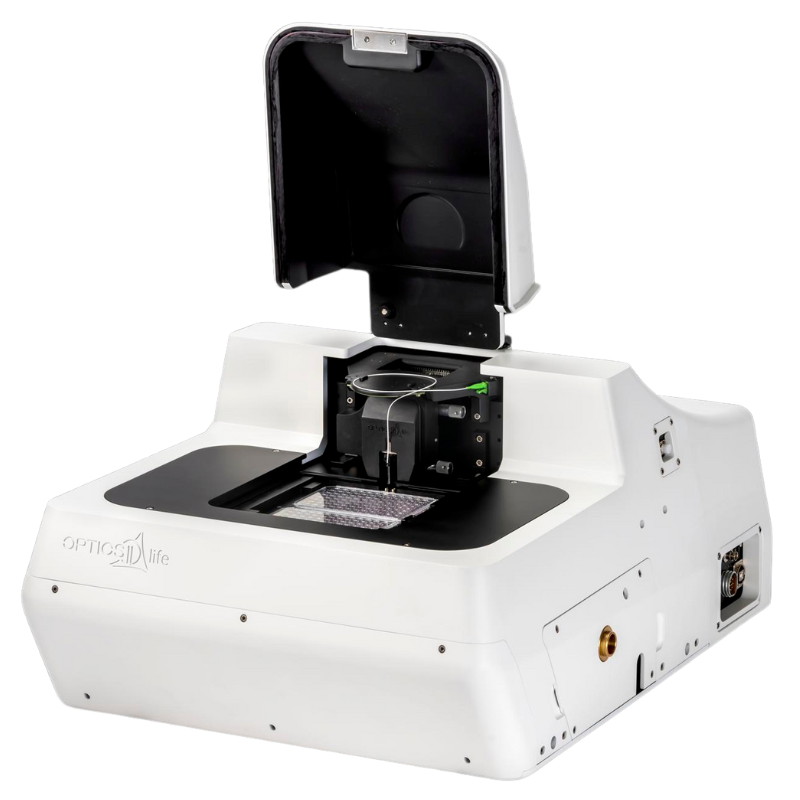
Making that vision real depends on more than fabrication. It requires knowing, with confidence, that a hydrogel’s mechanical properties are exactly what they’re supposed to be. That’s where precise measurement becomes scientifically critical, not just as a quality control step, but because a substrate that’s nominally 1 kPa but actually 4 kPa is telling cells something entirely different. The Optics11 Life’s Pavone nanoindenter has become an indispensable tool for that validation work, playing a central role in the development of new products, including stiffness-patterned substrates (Fig. 1) and dynamically tunable hydrogels that can reversibly change stiffness during live cell culture (Fig. 2).
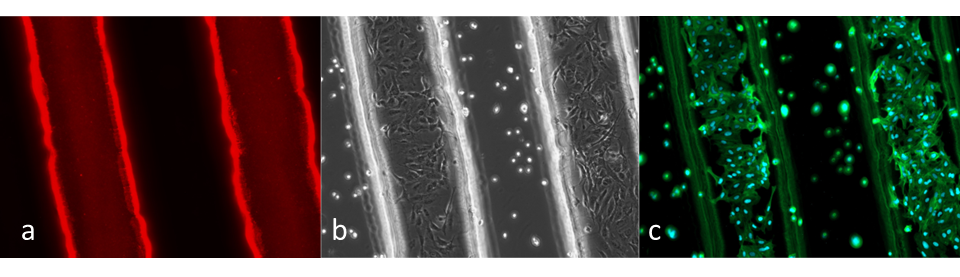
Figure 1 | Patterned stiffness (a) Alternating soft and stiff hydrogel bands. Stiff bands (100 kPa) are marked by red and are 135 µm wide; adjacent soft bands (0.1 kPa) are 265 µm wide, yielding a repeating 400 µm pattern. (b,c) Phase contrast and fluorescence images of A549 cells 48 h after seeding on patterned substrates. Nuclei are shown in blue and F-actin in green.
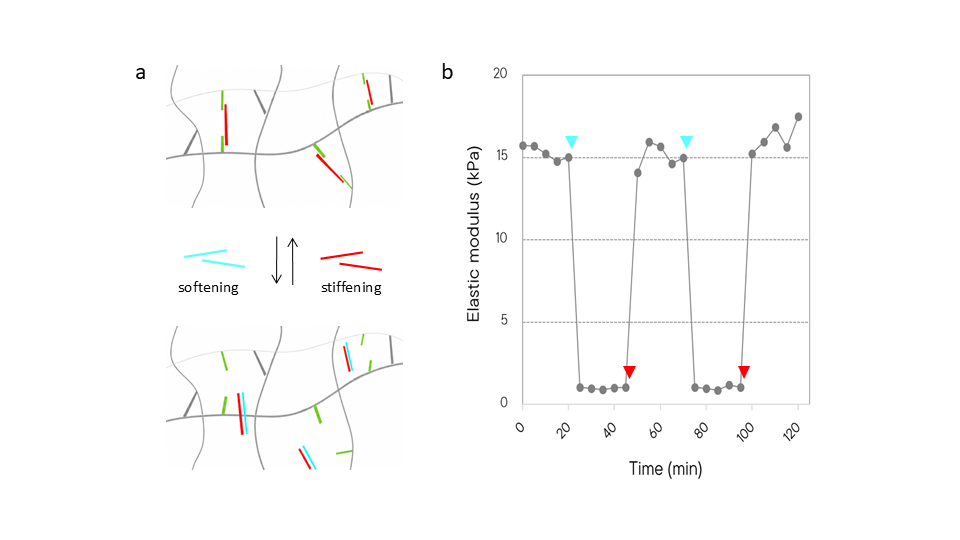
Figure 2 | Dynamically tunable stiffness (a) A polyacrylamide hydrogel modified with DNA oligo tails (green) is stiffened upon hybridization with complementary oligos (red) that bridge the tails, forming stable DNA crosslinks. Softening is achieved by addition of displacement oligos (blue) that compete for the bridge oligo and remove the crosslinks. (b) The same hydrogel can be stiffened and softened indefinitely. Here, stiff-soft-stiff-soft-stiff cycling was achieved by alternating addition of displacement (blue triangle) and bridge (red triangle) oligos at the indicated time points.
Today, mechanobiology is opening new frontiers across cancer biology, immunology, regenerative medicine, and tissue engineering. For Mih, stiffness is the literal framework, but it is only the beginning.
“The future lies in engineering environments that better mimic what cells actually experience inside the body,” Mih says. “For us, that means incorporating topographic cues, micropatterned extracellular matrix ligands, and tissue-like viscoelasticity into hydrogels themselves. The challenge is keeping these tools accessible for everyday cell culture.”
References
- Abbott A. Cell culture: biology’s new dimension. Nature. 2003;424:870-872.
- Discher DE, Janmey P, Wang YL. Tissue Cells Feel and Respond to the Stiffness of Their Substrate. Science. 2005;310(5751):1139-1143.
- Cosgrove BD, Bounds LR, Taylor CK, et al. Mechanosensitive genomic enhancers potentiate the cellular response to matrix stiffness. Science. 2025;390(6778):eadl1988.
- Bertero T, Oldham WM, Grasset EM, et al. Tumor-Stroma Mechanics Coordinate Amino Acid Availability to Sustain Tumor Growth and Malignancy. Cell Metabolism. 2019;29(1):124-140.e10.
- Hupfer A, Brichkina A, Koeniger A, et al. Matrix stiffness drives stromal autophagy and promotes formation of a protumorigenic niche. PNAS. 2021;118(40):e2105367118.
- Picariello HS, Kenchappa RS, Rai V, et al. Myosin IIA suppresses glioblastoma development in a mechanically sensitive manner. PNAS. 2019;116(31):15550-15559.
- Blache U, et al. Engineered Hydrogels for Mechanobiology. Nature Reviews Methods Primers. 2022.

Justin Mih
Justin Mih is the founder of Matrigen, a company he launched after completing his doctorate at the Harvard School of Public Health. He has spent his career building biomaterials that give research labs the tools they need to study cells in more physiologically relevant conditions – products now used by groups around the world. His approach to science was forged in part by a Fulbright fellowship in Russia, an experience that instilled an appetite for working across boundaries and a resourcefulness that has defined his work ever since.
Find out more about Matrigen via their website.
Interested in presenting your research in Faces of Mechanobiology?
Send an email to marketing@optics11life.com
Mentioned in this article:
Pavone
Pavone is automated and optimized for the biological workflow. It is a high-throughput, accurate, and easy-to-use solution that measures the local mechanical properties of cells, biomaterials, and 3D in vitro models.